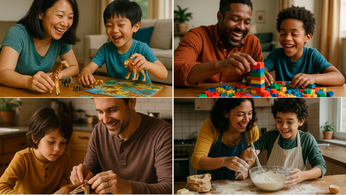

5 Ways Confidence Is Built Through Practice
Confidence isn’t something children are born with or magically acquire. It’s built slowly through everyday relationships.

Most parents worry about confidence at the wrong moment.
We wait until a child hesitates to raise their hand.
Until they avoid the tryout.
Until they say, “I’m just not good at this.”
By then, we’re already late.
Confidence isn’t something a child suddenly “has” or “doesn’t have.”
It’s something built quietly (through thousands of ordinary interactions) long before performance ever enters the picture.
Jeffrey Meltzer, a licensed mental health counselor based in Florida distilled this truth into five simple, practice-oriented habits. What makes them powerful is not novelty, but consistency. Together, they offer a blueprint that aligns deeply with how we think about giftedness at GiftedTalented.com.
Because gifts don’t become talents through pressure.
They grow through environments that invite courage.
1. Unconditional love creates psychological safety
Children take risks when love isn’t on the line.
When affection feels conditional (on grades, trophies, or behavior) children become conservative. They protect approval instead of exploring potential.
Unconditional love communicates something far more powerful than encouragement:
You are valued before you perform.
This is the soil where authentic confidence grows. It frees children to experiment with their gifts (intellectual, creative, social, or physical) without fear of losing belonging.
Psychological safety is what allows that fragility to survive long enough to mature.
2. Fair play teaches belonging
Confidence is not formed in isolation. It is deeply social.
Learning to take turns, lose gracefully, and play honestly isn’t just about manners—it’s about inclusion. Children who know how to stay included gain a quiet assurance:
I know how to be with others.
This matters more than many parents realize. Peer belonging shapes whether children feel safe expressing their gifts in classrooms, teams, and group settings. Social competence becomes a confidence multiplier.
3. Process praise builds durable belief
One of the most common confidence traps is praising outcomes instead of effort.
When children hear:
- “You worked hard on that.”
- “You stayed focused even when it was difficult.”
- “You tried a different strategy.”
They learn something essential:
My actions matter.
This shifts confidence away from fragile external validation and toward controllable behaviors—effort, persistence, and strategy. That shift is critical for turning early promise into long-term talent, especially when challenges inevitably arise.
4. Letting the child teach reinforces competence
Children internalize how adults see them.
Inviting a child to explain or teach something (paired with genuine curiosity) signals respect. It says:
You have knowledge worth sharing.
Over time, this practice reshapes identity. Children begin to see themselves not just as learners, but as capable contributors. For gifted children, this reinforces agency rather than dependence on adult approval.
5. Realistic positivity trains attention
What children notice repeatedly becomes what they believe.
A simple daily ritual—naming:
- something they did well
- a kind act they offered
- kindness they received
- good news in the world
- something they’re anticipating
doesn’t deny difficulty. It balances it.
This distinction matters. Confidence built on denial is brittle. Confidence built on realistic hope is resilient.
What this means for giftedness
Confidence is not the gift.
It is the carrier of the gift.
Without confidence, even extraordinary potential stays hidden.
With it, children are more willing to practice, refine, and persist long enough for raw ability to become real-world talent.
These five practices are not quick fixes. They are micro-investments—daily relational deposits that compound over time.
And that’s the deeper takeaway for parents, educators, and students alike:
You don’t build confidence by fixing children.
You build it by shaping the environment they grow in.
At GiftedTalented.com, we believe every child has a unique gift. Our responsibility is not to rush it into achievement, but to nurture it with patience, structure, and care until it’s ready to stand on its own.

GiftedTalented.com
The world's fastest growing gifted & talented community