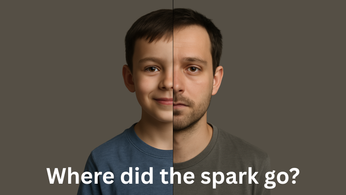

AI is scoring college essays and conducting interviews
As colleges turn to AI to manage scale and consistency, families face a new question: how do we ensure real gifts aren’t reduced to patterns?

The quiet shift we aren’t being told about
Most families still imagine college admissions as a deeply human process: an admissions officer reading a student’s essay late at night, trying to glimpse character, curiosity, and potential.
That picture is no longer fully accurate.
Across the US and globally, colleges are increasingly using AI systems to read, score, summarize, and even conduct first-round interviews with applicants. These tools are not experimental pilots. They are becoming part of the admissions infrastructure—driven by record application volumes, staffing constraints, and cost pressure.
Here’s the paradox that matters for families:
Students are warned not to use AI to write their essays—while colleges use AI to read them.
For intentional parents and educators, this isn’t a tech curiosity. It raises foundational questions about fairness, authenticity, and how giftedness is recognized and nurtured in a system increasingly mediated by machines.
What AI is actually doing in admissions (in plain English)
AI in admissions does not “understand” students. It detects patterns.
In practice, colleges use AI to:
- Score or co-score essays alongside human readers
- Summarize transcripts, activities, and recommendations into structured profiles
- Screen or triage applications before a human ever reads them
- Run structured interviews, where an AI voice asks questions and analyzes responses
- Flag potential AI-written essays using detection tools such as Turnitin
- Enforce application integrity rules on platforms like the Common Application
These systems are trained on past admissions decisions. That means they learn what worked before—not what might matter next.
Where AI Is Already Used in College Admissions
A quick guide for parents
AI in admissions is no longer theoretical. It is already being used—carefully and unevenly—across respected institutions. In most cases, AI supports human review rather than replacing it, but it increasingly shapes what humans see and when.
Essay Review & Screening
- Virginia Tech
Uses a hybrid essay-scoring model where an AI reader scores essays alongside a human reader. If scores diverge beyond a set threshold, an additional human reviewer steps in. - Large public universities (varies by school)
Use AI tools to summarize essays, activities, and recommendations, helping admissions teams manage application volume.
Interviews & Research Evaluation
- California Institute of Technology
Has piloted AI-mediated research interviews, where applicants explain projects to an AI voice. Faculty later review the recordings—AI structures the interaction but does not make final decisions.
Transcripts, Records & Scale Management
- California Community Colleges
Use AI to organize, summarize, and flag student records and transcripts across a massive system serving millions of students.
Admissions Operations & Communications
- Georgia Institute of Technology
Has explored AI tools for admissions-adjacent processes, including applicant communications and internal review workflows. - University of North Carolina at Chapel Hill
Has publicly discussed AI-assisted admissions operations, typically as part of broader campus AI initiatives.
AI Detection & Integrity Checks
- Many colleges use tools like Turnitin
to flag potential AI-generated writing, even though false positives remain a known concern. - Platforms like the Common Application
require students to disclose AI use and may treat undisclosed use as a violation of application integrity policies.
Why colleges like AI (and why parents should still ask hard questions)
From an institutional perspective, the appeal is obvious:
- Scale: AI can process hundreds of thousands of essays quickly
- Consistency: It doesn’t get tired or drift in standards
- Cost control: Fewer staff hours per application
- Speed: Faster initial decisions and triage
But efficiency is not the same as fairness.
And consistency is not the same as wisdom.
The real risk isn’t AI itself, it’s what AI tends to reward
Research on automated essay scoring and interview analysis points to several concerns that matter deeply for families:
1. AI often correlates polish with privilege
AI scoring systems tend to reward:
- Advanced vocabulary
- Familiar narrative structures
- “Standard” academic tone
These features track closely with access to coaching, resources, and socioeconomic advantage—sometimes more strongly than standardized test scores ever did.
That’s not because AI is malicious.
It’s because AI learns from history, and history is unequal.
2. Non-standard brilliance is harder for machines to see
Students who are:
- Neurodivergent
- Non-native English speakers
- Creative, nonlinear thinkers
- Early specialists (artists, builders, athletes, founders)
…often express themselves in ways that don’t fit clean textual molds.
Machines struggle here. Humans (attentive ones) do better.
3. Transparency is thin
Most AI admissions tools are proprietary. Families can’t see:
- What was scored
- How much weight AI had
- Whether an AI score prevented a human from reading the file
This matters because giftedness is contextual, not formulaic.
The new double bind students feel
Students today face an impossible-seeming task:
- Write essays that sound authentically human
- Avoid anything that looks “too polished”
- Compete against peers who may be using AI anyway
- Appeal simultaneously to humans and machines
- Hope they aren’t falsely flagged by an AI detector
Many teenagers describe this as writing for an invisible audience they don’t understand.
That pressure doesn’t nurture gifts.
It teaches performance under surveillance.
What we believe (and why this moment matters)
At GiftedTalented.com, we reject the narrow, test-centric definition of “gifted.”
We start from a different premise:
Every child is gifted.
The real question is whether adults notice early enough (and nurture wisely enough) to turn gifts into future-relevant talents.
AI systems, by design, favor what is:
- Already legible
- Already successful
- Already rewarded by institutions
They are inherently conservative tools.
That makes adult discernment more important than ever, not less.
What intentional parents can do—practically
1. Shift the goal from “impressing” to “revealing”
Encourage your child to write essays that:
- Tell specific stories
- Show lived experience, not generic ambition
- Explain context, constraints, and growth
Both humans and machines struggle with vague excellence.
2. Treat AI as a tool—not a ghostwriter
Ethical, increasingly accepted uses include:
- Brainstorming topics
- Grammar and clarity checks
- Researching schools and programs
What matters is ownership of voice.
3. Ask colleges better questions
Families should feel empowered to ask admissions offices:
- Does AI ever prevent a human from reading an application?
- How are AI interview or essay scores used?
- What safeguards exist for bias and appeal?
These questions signal seriousness—not suspicion.
4. Invest earlier, not later
By high school, students are already translating identity into narrative.
The most powerful advantage isn’t last-minute polishing.
It’s years of adults helping a child notice, develop, and articulate their gifts—in academics, arts, leadership, service, or creation.
A final thought for parents and educators
AI in admissions is not a temporary trend.
It’s a structural shift in how opportunity is filtered.
The danger isn’t that machines will replace humans.
It’s that we let machines define what counts as worthy before humans ever look closely.
In an age of algorithmic judgment, the role of parents and educators becomes more (not less) sacred:
- To see what systems overlook
- To protect emerging gifts from premature measurement
- To help young people grow into talents the future actually needs
That is the heart of gifted education as we understand it.
Not acceleration for its own sake.
But attention, discernment, and wise cultivation—before the machines decide.
If this topic resonates, explore more GT Insights on how emerging systems, from AI to admissions to credentialing, are reshaping what it means to nurture brilliance in the 21st century.

GiftedTalented.com
The world's fastest growing gifted & talented community