AI Isn’t Making Students Dumb
But something quieter, and more dangerous, is happening in education.

A surprising thing is happening in elite college classrooms.
Not rebellion.
Not cheating.
Not blind enthusiasm.
Fear.
At Dartmouth Tuck School of Business, professor Scott Anthony reports that many Gen Z MBA students are “scared, full stop” of artificial intelligence. Not because they think it’s unethical—but because they’re afraid of what relying on it might do to them.
Their anxiety isn’t about grades.
It’s about judgment.
Identity.
Humanity.
And that distinction matters deeply—for parents, educators, and anyone raising gifted young people in an AI-saturated world.
The Fear Beneath the Fear
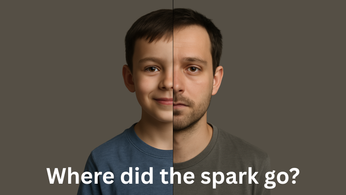
Much of the public conversation around AI in education fixates on cheating or productivity. But Anthony’s students are worried about something more subtle:
- If AI does the thinking, will I lose my edge?
- If everyone sounds smart, how do I become distinctive?
- If judgment can be outsourced, what exactly am I being trained to become?
This is not laziness talking.
It’s a fear of atrophy.
Recent headlines have amplified this concern. An MIT study popularly summarized as “Your Brain on ChatGPT” suggested that cognitive activity decreases when people rely heavily on AI tools. Media coverage quickly translated that into a blunt claim:
AI makes you dumb.
But two Australian researchers, Vitomir Kovanovic and Rebecca Marrone, pushed back. They argued the study design itself advantaged the non-AI group through repetition and familiarity—and warned against confusing early-stage tool use with long-term intellectual outcomes.
Their point matters:
Tools don’t make people weaker by default.
But unexamined dependence can.
When the Output Is Polished but the Mind Isn’t
Anthony noticed something unsettling in his own classroom.
The writing is… good.
All of it.
AI has effectively eliminated bad prose. But in doing so, it has also blurred an important signal:
the difference between fluency and understanding.
A beautifully written submission can now mask shallow thinking.
A rough, unfinished one may reveal deep engagement.
So Anthony changed how he teaches.
Instead of banning AI, he redesigned assessments to surface the process—the false starts, the reasoning, the wrestling. He grades for visible thinking, not surface polish.
This is a crucial insight for gifted education:
When excellence becomes frictionless,
formation becomes invisible.
“The Right Way Is the Hard Way”
Anthony borrows a principle from Jerry Seinfeld, who once joked about consultants by asking, “Are they funny?”
The point wasn’t anti-expertise.
It was anti-outsourcing excellence.
Certain forms of mastery—comedic timing, leadership judgment, moral discernment—cannot be delegated. They are earned through struggle.
Anthony summarizes this for students simply:
The right way is the hard way.
Using AI to lift every cognitive weight is like bringing a forklift into the gym. You can move the load, but you won’t build strength.
Why This Matters for Gifted Kids
For gifted students, this issue is even sharper.
Giftedness is not just speed or output.
It’s sensitivity to complexity.
It’s pattern recognition.
It’s judgment under ambiguity.
If AI removes all friction too early, students may never develop the inner musculature that turns raw ability into wisdom.
That doesn’t mean rejecting AI.
It means sequencing it correctly.
- First: struggle, wrestle, fail, revise
- Then: use tools to extend reach
- Always: know what you can do without the tool
This is how gifts become talents, and talents become leadership.
Julia Child Wasn’t a Superhero
Anthony often teaches disruption through ordinary persistence rather than mythic genius. One of his favorite examples is Julia Child.
She failed her first exam at Le Cordon Bleu.
Spent nearly a decade rewriting her cookbook.
Served her husband a famously disastrous early French meal.
Nothing about her story was frictionless.
That was the point.
Excellence emerged through resistance, not around it.
The Real Risk of AI in Education
The deepest danger of AI isn’t cheating.
It’s confusing assistance with formation.
If students never practice hard thinking, because a machine can do it faster, they may graduate articulate, confident, and strangely hollow.
Capable of output.
Untrained in judgment.
For future leaders, that’s a serious liability.
A Better Question for Parents and Educators
The question isn’t:
“Should students use AI?”
It’s:
“What kinds of thinking must remain deliberately hard?”
At GiftedTalented.com, we believe education should build durable inner capacities—not just impressive outputs. AI can be a powerful ally in that journey, but only if we design learning environments that protect struggle, preserve judgment, and honor the slow work of becoming human.
Because in an age where writing is easy,
thinking well becomes the true differentiator.

GiftedTalented.com
The world's fastest growing gifted & talented community