
When AI Enters Homework Time
Across China, families are turning to AI to survive the pressure of homework and schooling. What kind of children we are forming when we use AI for homework time?

What Our Families Can Learn from China’s Experiment with AI Parenting
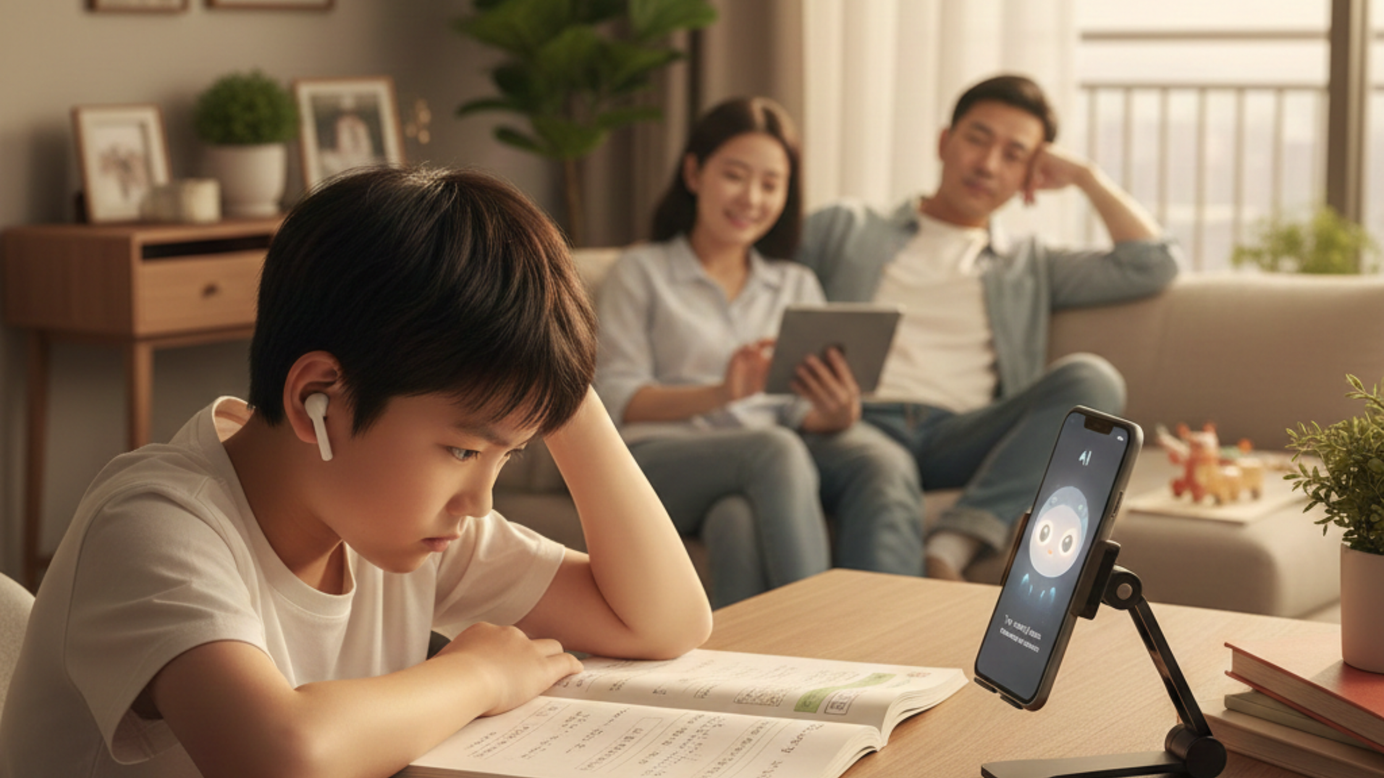
Across China, a new kind of homework helper has entered family life.
Parents are propping a phone on the desk.
An AI voice gently corrects posture, nudges focus, and explains mistakes.
Some children talk back to it. Others roll their eyes. Many parents sigh in relief.
The most visible example is ByteDance’s Doubao (also called Dola)—an AI learning app used inside a massive ecosystem with well over a hundred million monthly users. Parents aren’t using it to replace themselves. They’re using it to survive the daily pressure of homework, work, and expectations that feel nonstop.
For intentional families everywhere—especially those who believe every child is gifted by God and that talent must be formed (not forced or extracted)—this trend is worth paying attention to.
Not because we should copy it wholesale.
But because it clarifies a better question:
Not “Should we use AI?”
but “What role should AI play in the formation of a child?”
What’s Really Driving This Trend
The story isn’t about tech enthusiasm. It’s about pressure.
In many Chinese school systems, parents are expected to act as after-school co-teachers—monitoring assignments, uploading proof of homework, and responding instantly to class chats. Add economic strain, long work hours, and the legacy of one-child households, and something has to give.
AI homework monitors promise three things parents everywhere recognize instantly:
- Fewer nightly battles
- Lower cost than private tutoring
- The reassurance that a child is “keeping up”
In other words: reduced stress, not superior parenting.
That distinction matters.
What Should Give Intentional Families Pause
Experts quoted in coverage of these tools raise concerns that go deeper than privacy or screen time.
They point to something more subtle—and more important:
- Struggle is formative.
Frustration, disagreement, and even mild conflict help wire resilience and judgment. - Thinking doesn’t always look like focus.
Pausing, staring into space, or fidgeting can be signs of deep processing—not distraction. - Calm AI voices can confuse roles.
Children may begin to treat tools as companions instead of instruments.
For families committed to nurturing gifts into future-relevant talents, this matters enormously.
Because formation is not efficiency.
And peace at all costs is not the same as growth.
Tools Shape What We Become
At GiftedTalented.com, we hold a simple conviction:
Gifts are given.
Talents are developed.
Formation happens in relationship.
AI can assist learning.
It cannot replace formation.
So the question becomes:
What job does AI do in your family system?
A Framework for Intentional AI Use at Home
1. Define the Job Clearly
Use AI for mechanical support, not relational formation.
Good uses:
- Generating practice problems
- Explaining steps after a child has tried
- Reading instructions aloud
- Reviewing for basic errors
Avoid using AI for:
- Emotional comfort
- Moral guidance
- Evaluating character or effort
- Replacing human feedback
If the AI disappears tomorrow, the relationship should remain intact.
2. Preserve Productive Struggle
In gifted children, especially, struggle often arrives later—and hits harder.
Create a simple rule:
- Try first
- Mark where you’re stuck
- Use AI for hints, not answers
- Return to the problem
When homework gets tense, don’t rush to eliminate friction.
Treat it as information about load, readiness, or expectations.
3. Keep Adults Visibly in Charge
Children should know—explicitly—that:
- AI is a tool the family controls
- Adults set time limits and rules
- The AI does not “know” or “love” them in a human sense
Occasionally, review AI outputs together.
Model discernment.
Correct it when it’s wrong.
This teaches children something more valuable than answers: judgment.
Practical Guidelines for Intentional Families
1. Set Boundaries, Not Defaults
- Decide which subjects are AI-eligible (e.g., math drills, vocabulary)
- Reserve values-laden or identity-shaping topics for humans
- Avoid “always-on” camera monitoring that normalizes surveillance
2. Protect Privacy and Dignity
- Disable unnecessary cameras and microphones
- Don’t post homework clips of children online—even if they’re cute
- Treat learning moments as part of a child’s private formation story
3. Reinvest the Energy You Save
If AI reduces nightly conflict, spend that energy relationally:
- Walks
- Games
- Shared reading
- Unstructured conversation
Children need to feel supported, not just supervised.
4. Prepare Children for an AI-Rich World
Teach them to:
- Ask AI to explain its reasoning
- Compare outputs to class notes
- Catch and correct mistakes
- Notice how tools make them feel—empowered or dependent
Meta-learning matters more than mastery.
The Deeper Question Beneath the Tech
Chinese parents using AI monitors aren’t trying to raise machines.
They’re trying to raise children under pressure.
Intentional families all over the world can learn from this—not by copying the tools, but by refusing the false trade-off between peace and formation.
Because the goal was never:
- Perfect homework
- Quiet evenings
- Flawless focus
The goal has always been:
- Wisdom
- Resilience
- Judgment
- Purpose
AI can assist the work.
But formation remains human...and sacred.

GiftedTalented.com
The world's fastest growing gifted & talented community